In this guide
1. The commercial constraint is maintenance
On a residential project the owner absorbs maintenance personally and often enjoys it. On a commercial or HOA site, maintenance is a line item that gets tendered, squeezed and eventually reduced. Any planting that depends on skilled attention will degrade, because the attention will not be there in year three.
This changes the specification logic entirely. The right question is not “what looks best on handover” but “what still looks acceptable when it is mowed around by a crew on a fixed rate with no horticultural training”.
In practice that means favouring plants that tolerate hard shearing, recover from neglect, do not need deadheading, and do not die dramatically when irrigation fails for a week.
A useful test. If a plant needs to be pruned at a specific time of year to look right, it is a poor commercial specification. If it looks fine whenever it happens to get cut, it is a good one.
2. A durable core palette
| Role | Species | Why it works commercially |
|---|---|---|
| Screening / hedge | Clusia guttifera | Fast, dense, salt and drought tolerant, shears well |
| Screening / native | Cocoplum | Handles wet and dry, wind tolerant, low input |
| Formal hedge | Podocarpus | Holds a crisp line, slow enough to reduce trim frequency |
| Coastal buffer | Silver buttonwood | Very high salt tolerance, colour contrast |
| Mass colour | Thryallis | Near-continuous yellow, extremely heat tolerant |
| Mass colour | Ixora (dwarf forms) | Reliable with a micronutrient programme |
| Ground layer | Liriope / flax lily | Tolerates shear, edges cleanly, very low input |
| Structure | Sabal palmetto | Native, storm resilient, essentially maintenance-free |
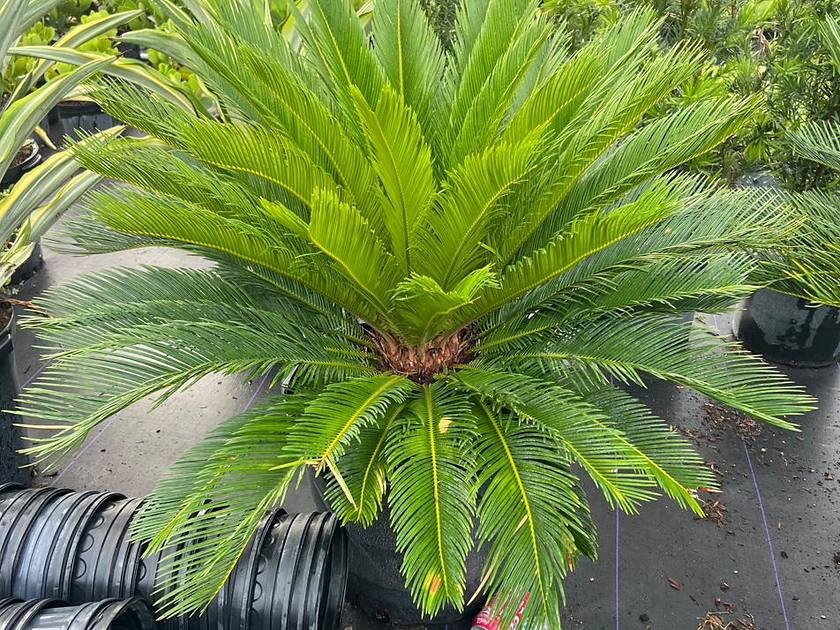
| Accent | Agave / coontie | Architectural, drought proof, no irrigation once set |
Note what is absent: anything requiring staking, deadheading, seasonal replanting, precise pruning windows or acid soil. Those belong in high-attention zones near entrances, if anywhere.
3. Grading and consistency
On a commercial run, consistency matters more than individual plant quality. Thirty clusia averaging four feet but ranging from three to five will read as a ragged hedge for years. Thirty plants all within six inches of each other read as a finished hedge from day one.
That needs to be written into the specification rather than assumed. Useful clauses:
- Container size and a height range — for example “7 gal, 42–48 in, matched”.
- A maximum height variance across a continuous run.
- A requirement that stock is nursery-grown and container-established, not recently potted from field stock.
- A root condition standard — no circling roots, root flare visible.
- The right to inspect and tag at the nursery before delivery.
That last one is the most useful in practice. On any substantial order it is worth walking the rows and tagging the actual plants, particularly for a frontage where uniformity is visible from the road.

4. Phasing supply to programme
Commercial construction programmes slip. Plants delivered to a site that is not ready sit in containers, need watering by someone whose job it is not, and deteriorate.
Phased supply solves it: material stays at the nursery under proper irrigation until the site can take it. For a large scheme that might mean three or four drops across several weeks, matched to areas becoming available.
It also helps to agree a holding arrangement in advance — how long material can be reserved, and what happens if the programme slips further. Both are easier to settle before an order than during a delay.
5. Irrigation and the specification
Plant specification and irrigation specification should be written together, and frequently are not. A drought-tolerant palette on a system designed for turf will be over-watered; a tropical palette on a low-output drip system will fail in the dry season.
At minimum, the specification should require separate zones for turf and beds, drip or micro-irrigation in shrub beds rather than spray, and a functioning rain sensor. Grouping plants by water requirement — hydrozoning — should be visible in the planting plan itself, not just in the irrigation drawing.
6. Substitutions and availability
Availability moves. A species specified in a drawing set eight months before installation may be short in the size required when the order is placed. The specification should say what happens then.
A workable substitution clause names an approved alternative for each key species, requires written approval before substitution, and holds the container size and grade constant. Without it, substitutions get made on site by whoever is available, and a carefully hydrozoned scheme quietly becomes a mixed one.
Talking to the grower early is the practical answer. Availability at a given size is knowable months ahead, and a grower can often plan production against a known programme.
7. Where commercial specs go wrong
- Palette too wide. Twenty species on a site that will be maintained by a general crew guarantees that some of them are treated wrongly.
- Under-sized stock on frontages. The saving is small and the visual deficit lasts two years, on the part of the site everyone sees.
- No grading standard. Produces uneven runs that cannot be corrected later.
- Ignoring mature size. Plants specified at nursery size and spaced accordingly become congested and get sheared into blocks.
- No aftercare period. The establishment window is when losses happen. A defined maintenance and replacement period protects everyone.
- Specifying plants that need acid soil without a micronutrient programme — chronic chlorosis on a commercial site looks like neglect, because effectively it is.
We supply commercial and HOA projects across Miami-Dade with phased delivery and consistent grading. See commercial landscaping, or send the plant schedule and we will price and programme it.
Frequently asked questions
What plants are best for commercial landscaping in Miami?
How should a commercial plant specification handle grading?
Can plants be delivered in phases for a construction programme?
How do you keep commercial landscape maintenance costs down?
What should a substitution clause say?
Do you supply HOA and property management projects?
How far ahead should commercial plant orders be placed?
References & further reading
- UF/IFAS EDIS — landscape plant selection and establishment
- Florida Nursery, Growers and Landscape Association
- Florida-Friendly Landscaping™ Program
Send us the plant schedule. We will confirm availability at size, price it, and phase the delivery against your programme. Get a quote or call (786) 283-3401.