

1. Choosing by role, not by name
Most people arrive with a plant name. It works better in reverse — decide what the plant has to do, then pick the species.
- Screen a boundary. Density and mature height matter most. Clusia if you have depth, podocarpus if you do not.
- Hold colour year-round. Foliage beats flower. Copperleaf and variegated arboricola carry colour through months when nothing is blooming.
- Survive an exposed edge. Salt and wind tolerance. Silver buttonwood and cocoplum.
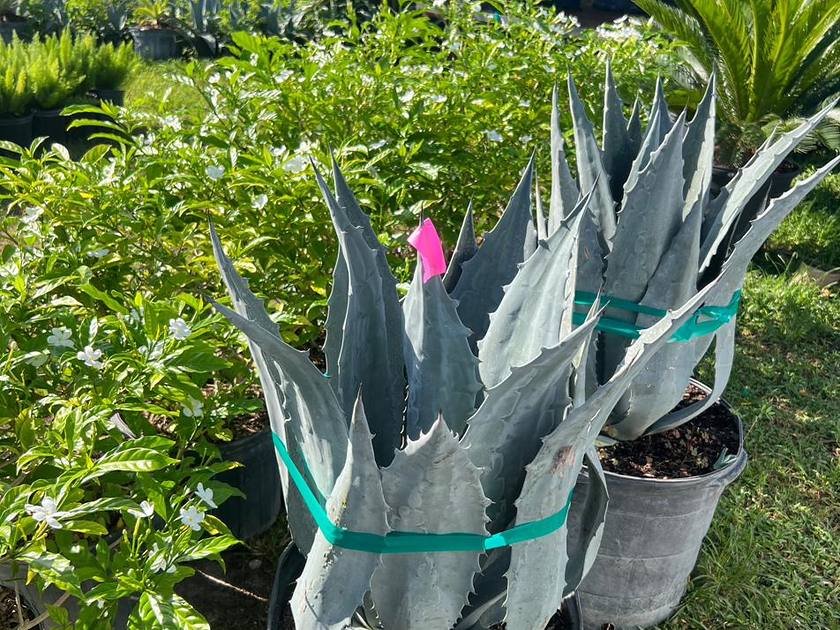
- Anchor a bed. Form and structure. A single agave does more than a dozen small plants.
- Cover ground cheaply. Spread rate. Blue daze, flax lily.
Full range on the plants page, and photographs of every species in the gallery.

2. Specifying for Miami-Dade conditions
Three site factors override almost everything else here.
Light. Measure it honestly across a whole day. Under four hours of direct sun, sun-loving species thin out regardless of feeding. That is the single most common cause of a scheme that looks tired within two years.
Drainage. Fill a foot-deep hole with water. Not drained in two to three hours means you plant on a raised mound or you change species. Standing water kills more plants here than drought does.
Salt. Near the water, distinguish spray on the wind from salt in the soil from brackish irrigation — they call for different responses. Our salt guide covers reading the damage pattern.

3. Residential and commercial
Residential work is usually a boundary, a frontage or a bed that has stopped working. Small enough that plant quality and correct spacing decide the result.
Commercial and HOA work adds constraints: consistency across multiple properties, phased scheduling, and planting that still looks deliberate after five years of contract maintenance. Uniform stock from one grower matters considerably more at this scale — matching across suppliers is where multi-property schemes visibly fall apart.
See residential landscaping and commercial landscaping.

4. Why the growing row matters to your project
Where a plant comes from changes how a scheme holds up — most visibly on anything that runs for length or repeats across a site.
One batch for long runs. A hedge or a frontage pulled from a single growing row matures evenly, because every plant shared the same soil, water and sun from the start. Stock assembled from several suppliers to fill one order rarely matches, and the difference shows within a season.
Delivery synced to the build. Because we grow what we supply, we can hold plants at size and release them in phases — hardscape first, planting when the site is ready — instead of everything landing on day one to sit and decline in pots. See plant delivery.
One accountable party. Grower and supplier are the same people, so there is no gap between who raised the plant and who answers for it. If something needs replacing, it comes from the same stock — so the repair matches the original rather than standing out. That continuity is the core of buying grower-direct.
Send the site photographs and rough measurements. We will come back with a species list, quantities and spacing. Start there.