
1. Why bloom length matters more than bloom size
People choose flowering plants from a photograph taken at peak. That photograph is frequently the only three weeks that plant looks like that.
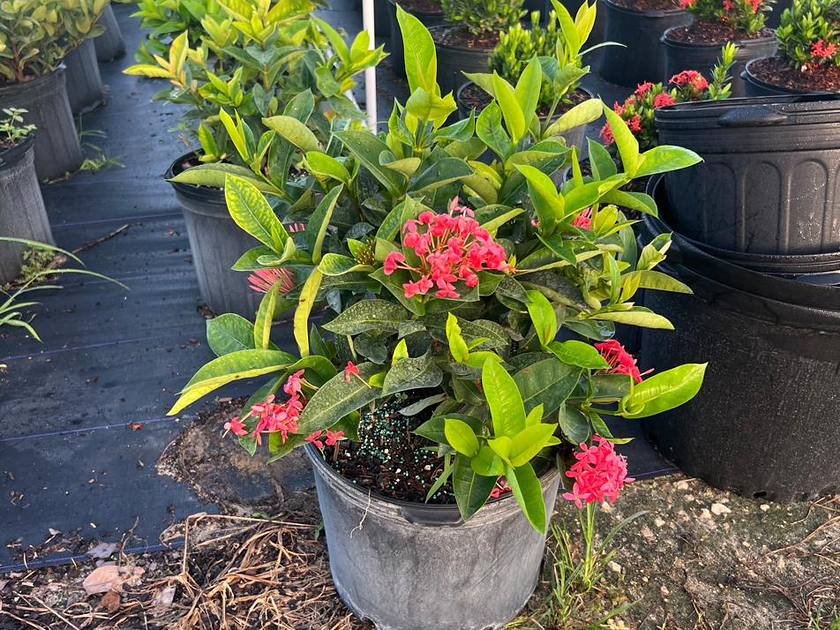
The more useful question is how many months of the year a species carries flower. In Miami-Dade, ixora will bloom nearly continuously in full sun. Blue daze opens fresh flowers every morning through most of the year. Those two do more for a garden than a spectacular species with a short window.
Build the bed on foliage structure, then use long-flowering species as the colour layer. That way there is no dead season.


2. Ixora, and getting it right
Ixora is the workhorse flowering shrub of South Florida, and it is also the plant we most often see struggling.
What it needs: full sun — six hours minimum, more is better. In shade it thins, stretches and stops flowering, and no amount of feeding fixes that.
The common problem: pale new leaves with green veins. That is iron lockout from our alkaline soil, not a lack of fertiliser. Ixora is unusually prone to it. The fix is chelated micronutrients, covered in our yellow leaves guide.
Standard or dwarf: standard ixora makes a substantial flowering hedge. Dwarf ixora gives the same colour at a fraction of the footprint — the right call for foundation beds, low borders and tight front yards.

3. Flowering groundcover
The layer most schemes underuse.
Blue daze forms low spreading mounds covered in true-blue flower that opens each morning. Genuinely blue flowers are uncommon, and it holds up in full sun on very little water. Pollinators find it within days.
Massed along a walkway, at the front of a bed, or filling a hot strip where turf struggles, it delivers more visible colour per dollar than almost anything else — because it covers area rather than occupying a single point.

4. Combining the layers so there is no dead season
The gardens that look good every month of the year are almost never planted with flowers alone. They are built in layers, and flower is only one of them.
Structure first. A backbone of foliage — copperleaf, arboricola, clusia — carries the bed when nothing is blooming. Colour-leaf plants like copperleaf do double duty: they read as colour all year without depending on flower at all.
Flower as the middle layer. Standard or dwarf ixora sits in front of that structure and supplies near-continuous red and coral. Because the foliage behind it never goes bare, the occasional lull between ixora flushes is invisible.
Groundcover at the front. Blue daze or dwarf ixora finishes the edge and covers the soil, so there is no strip of bare mulch and no gap for weeds. Three layers, each doing one job, is what produces a bed that photographs well in July and in January.
If you tell us the light, the mature size you want, and the colours you like, we will grow and supply the layers as a set rather than as a random handful of plants. That is the difference between a planting and a scheme.
Tell us how much sun the bed gets. With flowering plants that single number decides almost everything. Ask us.