
Clusia
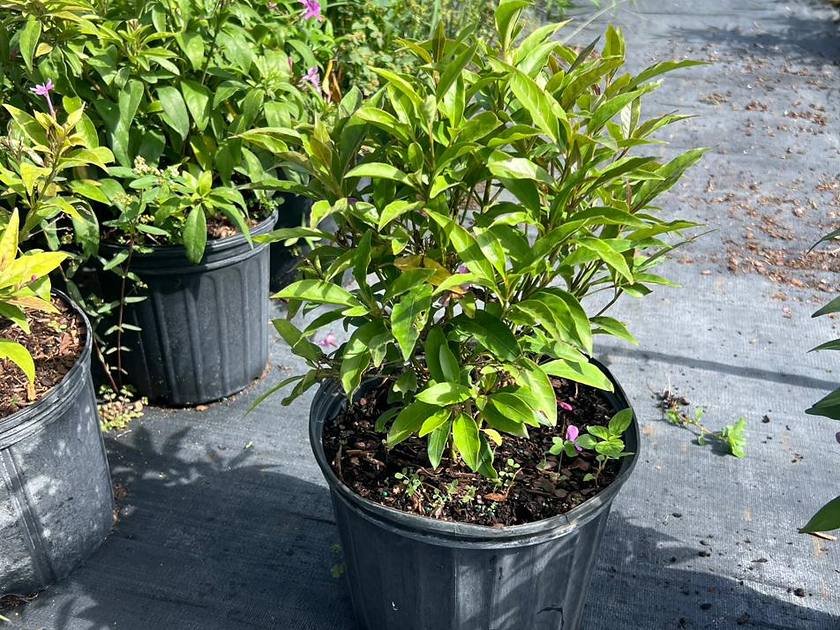
The default Miami privacy hedge — dense, glossy, salt-tolerant and quick to close a fence line.
Everything here is raised in Miami-Dade sun, sand and rain. It does not have to adapt when it reaches your yard.
The plants that succeed in Miami-Dade are built for heat, intense sun, sandy alkaline soil and — near the coast — salt air. That means clusia for privacy screening, ixora and copperleaf for colour, silver buttonwood for exposed coastal sites, and agave and flax lily for low-water accent planting. Everything below is grown at our nursery at 19995 SW 177th Ave, Miami, FL 33187.
Filter by what you are trying to achieve — privacy, colour, salt tolerance or low maintenance.
The default Miami privacy hedge — dense, glossy, salt-tolerant and quick to close a fence line.

Clusters of red and coral bloom almost continuously in full sun. Hedge it or let it mound.

Same colour, smaller footprint — ideal for low borders, foundation beds and tight front yards.

Silver-grey foliage, Florida native, and one of the toughest things you can plant near salt air.

Gold-and-green foliage that lights up shaded corners. Hedges well and asks for very little.

Colour without flowers — bronze, crimson and copper leaves that hold all year in full sun.

Strappy cream-edged blades that hold form with almost no attention. Excellent massed along walks.

Architecture, not maintenance. One specimen anchors a bed and survives on rainfall alone.

Low spreading mounds of true-blue flower, opening every morning. Pollinators find it within days.
Availability moves with the season. Call (786) 283-3401 before driving out for something specific.

Most people arrive with a plant name. It works better the other way round — tell us the situation and we will name the plant.
“I need to block a neighbour’s second floor.” “This strip bakes all afternoon.” “I am two blocks from the water.” Each of those has a different right answer, and getting it wrong is expensive. It is also the conversation a grower is most useful for.
Everything here is grown at our nursery in southwest Miami-Dade. The stock changes through the year, and the right choice depends far more on your conditions than on which plant looks best in a photograph. Three questions settle most of it.
This is the single most useful number, and people consistently over-estimate it. Look at the bed at 9am, midday and 4pm on a clear day and count actual direct sun. Six or more hours opens up the full flowering palette — ixora, thryallis, plumbago, bougainvillea, croton. Below about four hours, flowering shrubs will grow perfectly well and simply refuse to bloom, and the better strategy is foliage colour instead: variegated arboricola, ti plant, wild coffee, ferns.
Walk the area an hour after a summer storm. Water standing for more than a few hours means the site is genuinely wet, and that narrows the palette to species that tolerate periodic saturation — cocoplum above all. Trying to grow drought-adapted plants in a wet pocket produces a slow decline that looks like underwatering and gets treated with more water.
Growth rates here are much faster than most plant labels assume. A clusia sold at eighteen inches becomes a twelve-foot shrub; a philodendron in a nursery pot becomes eight feet across. Check mature size before anything else, and where a plant is right in every respect except scale, there is usually a dwarf cultivar bred for exactly that problem.
| Container | Typical height | Best used for |
|---|---|---|
| 3 gallon | 2–3 ft | Groundcover, fast shrubs, budget runs where you can wait |
| 7 gallon | 3–4 ft | The common residential hedge starting point |
| 15 gallon | 5–6 ft | Usable screening quickly; small trees |
| 25 gallon | 6–8 ft | Near-immediate privacy; needs equipment to place |
| 45 gallon+ | 8 ft+ | Instant effect, specialist installation |
You are essentially choosing between paying with money or paying with time. Both routes end in the same place. For groundcover and fast shrubs, buy small — they fill in within a season. For trees and screening where you want height now, larger stock is usually worth it.
Come and look. Photographs are poor at conveying foliage and grading. Call ahead on (786) 283-3401 and we will have what you are after pulled and ready to inspect — including sliding one out of its pot so you can check the roots.
Two minutes with someone who grows here beats two hours of research.