Miami-Dade soil is sand over limestone: it drains fast, holds almost nothing, and chemically locks out the nutrients plants need most. These guides cover planting depth, backfill, the first eight weeks of watering, feeding for alkaline soil, and how to read what a struggling plant is
The single biggest cause of a new plant failing here is not the plant — it is the first eight weeks of watering. Sandy soil drains so fast that a plant can be under-watered even after heavy rain, because its small root ball dries out long before the surrounding ground looks dry. Frequent, deep, early watering is what carries it through.
Feeding works differently in alkaline soil. High pH chemically locks up iron and manganese, so plants can yellow between the veins even when the nutrient is present in the ground. Reading those symptoms correctly, and feeding for alkaline conditions rather than guessing, is what separates a plant that limps along from one that fills in.
All 5 guides
How to Plant a Shrub in Miami’s Sandy Soil
Nearly every plant we are asked to diagnose was planted wrong. Usually too deep, occasionally in a hole that was too narrow.
Read the guide · 7 minPlanting & CarePruning in Miami: What to Cut and When
Without a dormant season the timing rules change. When to prune, what never to cut between August and October, and why light and frequent beats hard and occasional.
Read the guide · 7 min Planting & CareWatering New Plants in Miami: The First 8 Weeks
More new plants die from watering mistakes in Miami than from anything else — and roughly as many from too much as too little.
Read the guide · 6 min Planting & CareWhy New Leaves Turn Yellow in Miami Soil
It is the most common photo we get sent. In Miami the cause is usually soil chemistry rather than anything you did.
Read the guide · 6 min Planting & CareFertilizing Plants in Miami’s Sandy Alkaline Soil
Our soil drains fast, holds very little, and chemically locks out the nutrients plants need most.
Read the guide · 6 min Planting & CareWhy New Plants Fail in Miami: 7 Causes
People arrive convinced they bought bad plants. Occasionally true. Far more often it is one of seven things, and most were decided on planting day.
Read the guide · 7 minFrequently asked questions
How often should I water a newly planted shrub in Miami?
Why are my plant’s leaves turning yellow between the veins?
How deep should I plant a shrub?
How long does establishment take in Miami?
Why is my new plant dry when the bed is wet?
Should I fertilise a newly planted shrub?
Browse another category
The first eight weeks decide most of it
Plants are rarely lost because of the plant. They are lost in the establishment window, and almost always to a watering pattern in one direction or the other.
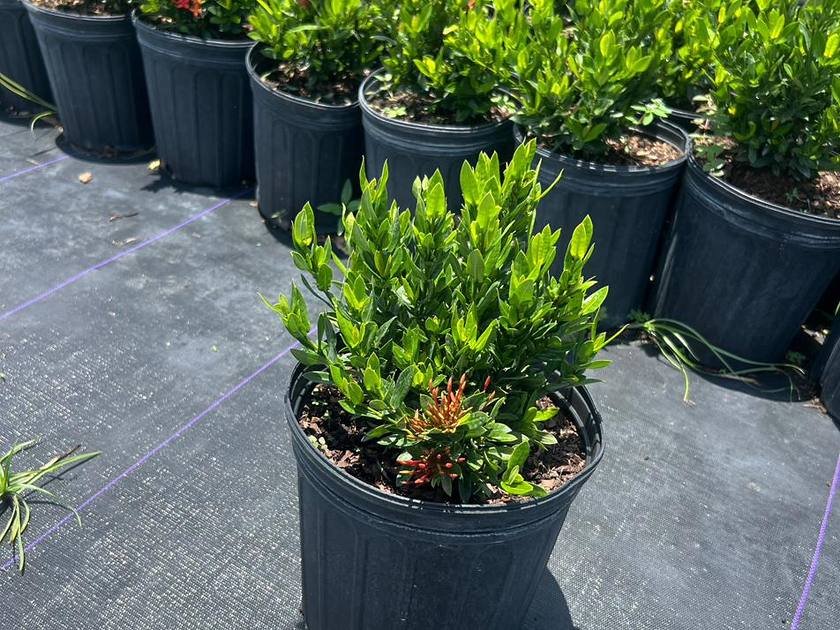
A newly planted shrub has a root ball surrounded by soil its roots have not reached. Until it roots out it is effectively still in a container — and container media dries far faster than the ground around it. That is why a new plant can be bone dry in the middle of a moist bed, and why water needs applying over the root ball specifically rather than to the bed generally.
The pattern that works: daily for the first two weeks, alternate days for weeks three to six, every third day to week eight, then taper toward the normal schedule. Deep and slow each time rather than brief and frequent — short cycles wet only the top two inches of sand and build a shallow root plate that cannot survive a hot week.

At week six, take the stem near the base and pull gently. A plant that has begun rooting out resists. One that moves freely in its hole has not established and needs continued attention rather than a diagnosis.
The other four things that matter
- Depth. Root flare visible, never buried. In sand, an inch proud of grade is the safer error.
- Backfill. Native soil, not a compost pocket — rich material in one hole behaves like a buried container.
- Mulch. Three inches across the whole bed, three to four inches clear of every stem.
- Feeding. Little and often, with chelated micronutrients. In our alkaline soil, iron availability is usually the constraint rather than nitrogen.
Diagnosing a problem? Work from the ground up — watering pattern, planting depth, drainage, nutrient availability, then pests. See why new plants fail and why leaves turn yellow.