1. Quick comparison
| Hedge | Growth | Spacing | Salt | Shade | Maintenance |
|---|---|---|---|---|---|
| Clusia | Fast | 2–3 ft | High | Low | Low |
| Podocarpus | Moderate | 2–2.5 ft | Moderate | Moderate | Low–med |
| Areca palm | Fast | 3–4 ft | Moderate | Moderate | Low |
| Cocoplum | Moderate | 2–3 ft | Very high | Low | Low |
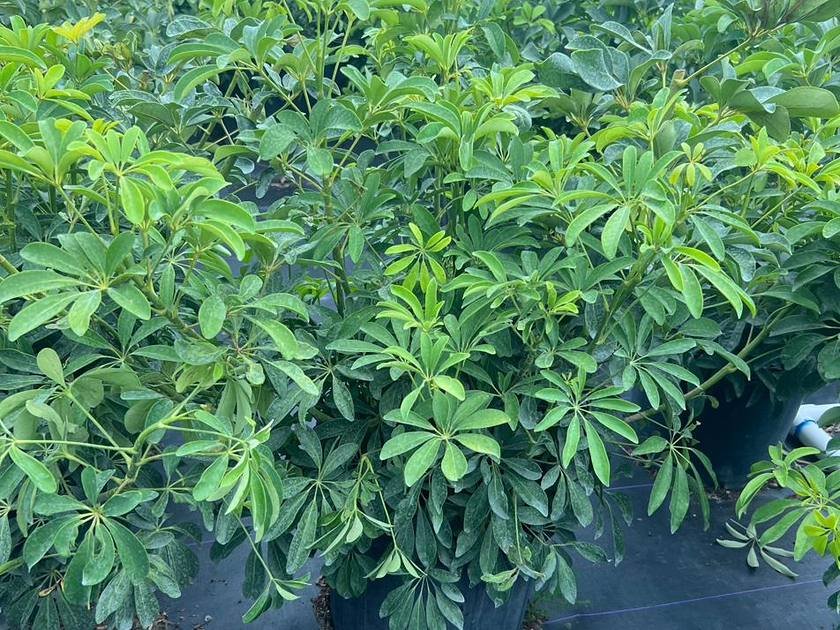
| Arboricola | Moderate | 2–3 ft | Moderate | Good | Low |
| Ficus | Very fast | 2–3 ft | Moderate | Moderate | High |
Figures are typical for Miami-Dade in full sun with regular irrigation, and vary with soil, exposure and care.

2. Clusia — the default recommendation
Clusia is what we recommend most often. Thick, glossy, paddle-shaped leaves make a genuinely opaque screen, and it handles salt, wind, heat and drought once established. It also tolerates being cut back hard without sulking.
Growth is quick in full sun, so a 3-gallon hedge closes within a couple of seasons at sensible spacing.
The catch: clusia wants to be wide. If your available depth is under about three feet you will be fighting it, and podocarpus is the smarter choice for narrow side yards.
3. Podocarpus — for a formal wall
Podocarpus gives the clean, dark-green architectural hedge you see fronting well-kept Coral Gables and Pinecrest properties. Fine needle-like foliage takes a crisp edge and holds it in a way clusia never quite does.
It is slower, so you are either patient or you buy taller stock. It stays narrower, which makes it right for tight side yards and beds against a wall. Salt tolerance is only moderate — a weaker choice within direct spray of the bay.
4. Areca palm and cocoplum
Areca palm makes a layered, feathery screen with a resort feel, and is excellent around pools where a clipped hedge looks severe. It screens differently though — dense in the middle, more open low down and at the top. Walk the sightline you are trying to block before committing.
Cocoplum is a Florida native with exceptional salt tolerance. It clips into a respectable hedge, needs little water once established, and handles coastal exposure that would burn most alternatives — the right answer in Cutler Bay and along the bay.
5. Ficus — think carefully
Ficus grows faster than anything else here and makes a beautiful dense wall. It is also responsible for a great deal of hedge regret in South Florida.
- Aggressive roots that damage foundations, driveways, pipes and pool decks
- Frequent trimming — often every four to six weeks in growing season
- Whitefly pressure, which has caused significant defoliation across the region
- Scale — it wants to be a very large tree and never forgets it
With budget for regular professional maintenance and space away from hardscape, it performs. Most homeowners are better served by clusia.
Measure the run and the depth. Those two numbers plus your timeline decide species, pot size and spacing — and they change the cost more than plant choice does. Get a quote or call (786) 283-3401.