In this guide
1. Sun is the whole answer
Almost every complaint about a shrub that will not flower in Miami traces back to light. Flowering is expensive for a plant; it will only do it when it has surplus energy. Below about six hours of direct sun, most flowering shrubs put what they have into foliage and stems and stop there.
Measure it honestly before choosing anything. Look at the bed at 9am, noon and 4pm on a clear day and count actual direct sun. People consistently over-estimate — a bed under a high canopy that feels bright is often getting three hours of true direct light.
Six hours is the practical threshold. Below it, a flowering shrub becomes a foliage shrub. That is not a failure of care — it is the plant behaving correctly.
2. The reliable year-round performers
| Plant | Colour | Sun | Habit | Notes |
|---|---|---|---|---|
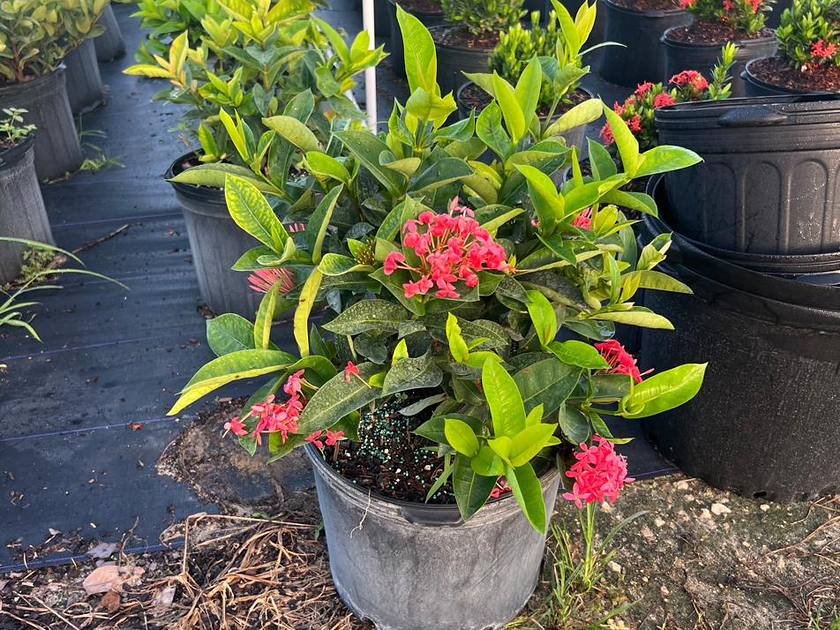
| Ixora | Red, orange, pink, yellow | Full | 2–5 ft shrub | Near-continuous with micronutrient feed |
| Bougainvillea | Magenta, red, orange, white | Full | Vine or shrub | Flowers best kept dry and lean |
| Plumbago | Sky blue, white | Full–part | 3–4 ft mound | Tough, long flushes, low maintenance |
| Thryallis | Yellow | Full | 4–6 ft shrub | Almost continuous, very heat tolerant |
| Firebush | Orange-red | Full | 5–8 ft shrub | Florida native, draws hummingbirds |
| Pentas | Red, pink, purple, white | Full–part | 18–30 in | Butterfly magnet, replant every few years |
Ixora deserves a note. It is the most planted flowering shrub in Miami and the most commonly disappointing, almost always for the same reason: it wants acidic conditions and our soil is alkaline. In high-pH sand it goes chlorotic, stops flowering and looks permanently unwell. With a chelated micronutrient feed two or three times a year it becomes one of the best-value flowering plants available here.
Bougainvillea is the opposite problem — it fails from kindness. It flowers in response to mild stress, so a plant on an irrigation zone with regular fertiliser produces vigorous green growth and almost no bract colour. Plant it where it will be somewhat neglected.

3. Seasonal colour worth having
Some plants do not flower continuously but earn their place with a spectacular flush.
- Tabebuia / trumpet tree. A few weeks of complete yellow or pink saturation in late winter, on a bare tree. Nothing else in the Miami landscape does that.
- Frangipani (plumeria). Heavily scented flowers through the warm months, deciduous in the cool. The bare-stem winter look is part of the deal.
- Hibiscus. Individual flowers last a day; a healthy plant produces them continuously through the warm season. Prone to erineum mite in Miami-Dade, which needs managing.
- Crape myrtle. Long summer flowering, good small-tree structure — but avoid the hard “crape murder” pruning that ruins the form.
- Jatropha. Coral flower clusters nearly all year in full sun, on a small tree or large shrub.
4. Shade: use leaves instead
Under canopy, stop trying to force flower and use foliage. It is more reliable, holds twelve months a year, and reads as more considered.
Croton for saturated multi-colour, ti plant for burgundy and pink verticals, caladium for summer patterning, variegated arboricola for gold-and-green brightness, and bromeliads — which flower in shade where almost nothing else will, and hold colour in the leaf regardless.
Our guide to plants for shade in Miami covers this palette in more depth.

5. Why flowering stops
- Not enough sun — by a very large margin the most common cause.
- Too much nitrogen. High-nitrogen lawn fertiliser drifting into beds pushes leaf at the expense of flower. Use a balanced or bloom-oriented feed in planting beds.
- Pruned at the wrong time. Cutting a shrub that flowers on old wood in spring removes that year’s flower buds. Prune just after a flush, not before one.
- Over-watering — particularly bougainvillea and plumeria, both of which flower better slightly dry.
- Micronutrient lock-out in alkaline soil, which shows first as pale foliage and then as reduced flowering.
- Age. Some flowering perennials — pentas especially — simply decline after three or four years and are best replaced.
6. Designing for continuous colour
A bed that always has something in flower is built from overlapping flushes rather than a single star performer. The simplest reliable structure is a backbone of two or three continuous bloomers — thryallis, plumbago, ixora — with seasonal accents layered in front, and enough foliage colour that the bed still reads well in a gap between flushes.
Plant in groups of three or five rather than singly. A single plant of six varieties looks scattered; three plants each of two varieties reads deliberate and holds colour more visibly from a distance.
See what we currently have in flower on the flowering plants page, or tell us the light levels and we will build the list.
Frequently asked questions
What flowers bloom year-round in Miami?
Why is my ixora not flowering?
Why does my bougainvillea have no flowers?
What flowering plants grow in shade in South Florida?
When should I prune flowering shrubs in Miami?
What is the best fertiliser for flowering plants in Miami?
References & further reading
Tell us how much sun the bed gets. With flowering plants that single number decides almost everything — send us a photo and the hours, and we will build a list that actually blooms. Get a quote or call (786) 283-3401.