In this guide
1. Measure your shade before you buy anything
People estimate sun exposure from memory and get it consistently wrong. Canopy moves, buildings cast differently through the year, and a spot that feels bright at 9am may be in shadow by eleven.
Photograph the area three times in one day — morning, midday, late afternoon. Count the hours of direct sun that actually land on the planting position, not on the general area.
- Six or more hours: full sun. Everything is available to you.
- Four to six hours: partial sun. Shade-tolerant species will thrive, sun-lovers will be adequate rather than good.
- Two to four hours: genuine shade. A short list only.
- Under two hours: deep shade. Be honest — planting here is fighting physics.

2. The species that genuinely perform
Variegated arboricola is the best answer available. The gold-and-green foliage actively brightens a dark corner rather than disappearing into it, and it hedges well enough to screen. It holds colour under canopy where clusia goes thin and bare at the base.
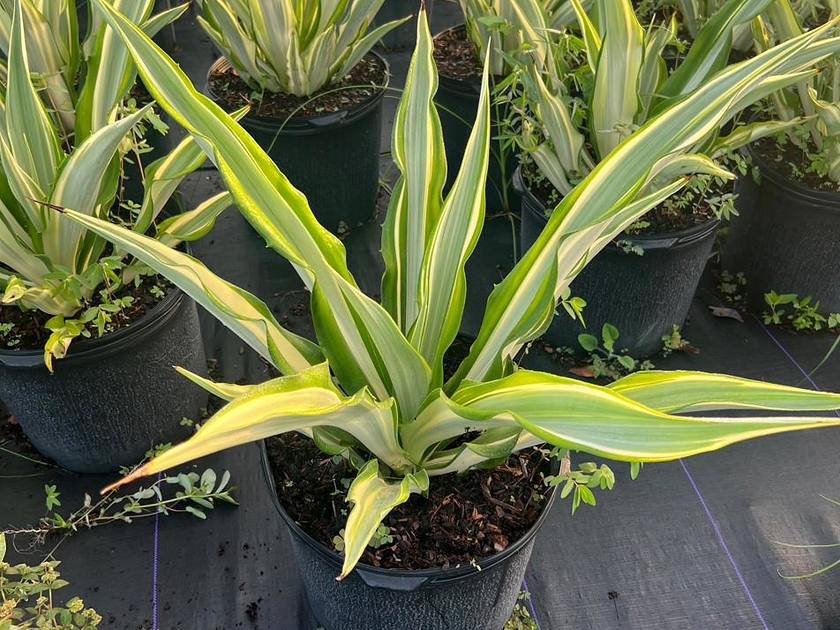
Variegated flax lily handles both sun and shade, which makes it valuable for beds that transition between the two. Strappy cream-edged blades, no maintenance to speak of, and it holds its form indefinitely.
Wild coffee, a Florida native, tolerates shade unusually well for a tough native. Deeply veined glossy leaves, red berries, and it draws birds.
3. What will not work, however well you treat it
Clusia in shade goes leggy, thins at the base, and never closes as a screen. It is the most common disappointment we hear about.
Ixora stops flowering. It may survive, but the flower is the entire reason to plant it.
Agave loses its form and rots more readily in the damp low-light conditions under canopy.
Turf thins progressively no matter how it is fed. Converting shaded lawn to mulched bed or groundcover ends a recurring annual problem.
No amount of fertiliser substitutes for light. If a plant needs full sun and you have three hours, the plant is wrong for the site — which is a cheaper conclusion to reach before buying.
4. Changing the conditions instead
Sometimes the better move is editing the shade rather than accepting it.
- Selective canopy thinning. Removing some interior branches lets dappled light through without losing the tree. Frequently this is the difference between three hours and five.
- Raising the crown. Removing lower limbs lets low-angle morning and afternoon light in underneath.
- Check local rules first. Several Miami-Dade municipalities regulate tree work — Coral Gables more closely than most.
- Use reflected light. A pale wall behind a shaded bed measurably increases what reaches the plants.
This matters most in Pinecrest, South Miami and Palmetto Bay, where mature canopy is the defining feature of most properties.
Photograph the spot at morning, midday and late afternoon. Those three images tell us the light, and the light decides the plant. Send them over.