In this guide
1. Roots first, always
Almost everything that determines whether a plant establishes is in the root ball, and almost nobody looks at it. Ask to slide a plant part-way out of its container — any reasonable nursery will let you, and reluctance is itself informative.
What good looks like: pale, firm roots visible at the edge of the ball, distributed evenly, holding the soil together without dominating it. The medium should smell earthy.
What to reject: a dense mat of roots circling the inside of the pot; a thick root spiralling around the base; roots pushing hard out of the drainage holes; dark, soft or slimy roots; a sour smell; or a root ball that falls apart completely, indicating recent potting-up.
Circling roots matter more than they look. A root that has spiralled in a container will often continue spiralling after planting, eventually girdling the plant’s own stem. On shrubs it produces slow decline; on trees it can cause failure a decade later.
The single most useful buying habit. Look at the roots of at least one plant from any batch you are buying in quantity. On a hedge run of thirty plants it takes two minutes and tells you more than looking at all thirty canopies.
2. Structure
Look at the plant as a framework rather than as foliage.
- Is the root flare visible? A stem disappearing straight into the potting mix without widening usually means it has been potted too deep — a defect that carries into the ground.
- Single dominant leader or even multi-stem? For trees and standards, one leader. For shrubs, evenly distributed stems rather than everything emerging from one side.
- Branching from low down? On hedging plants, foliage that starts near soil level is what gives a screen density at the base. A shrub bare for its first eighteen inches will screen nothing at ground level.
- No tight V-shaped unions on woody plants, and no obvious wounds or stubs.
- Does it stand up unsupported? A plant that flops when the stake is removed has been grown too fast or too close to its neighbours.
3. Foliage
Foliage is what everyone looks at, and it is the third most useful indicator rather than the first — but it still says a lot.
Uniform colour across the plant, appropriate to the species. Yellowing between green veins on new growth suggests a micronutrient problem that has been going on for some time. Uniform pale colour on older leaves suggests underfeeding. Brown crisp edges suggest inconsistent watering.
New growth at the shoot tips is a good sign: it means the plant is actively growing rather than sitting stalled. Leaf size that drops noticeably on the newest growth suggests the plant has been under stress recently.
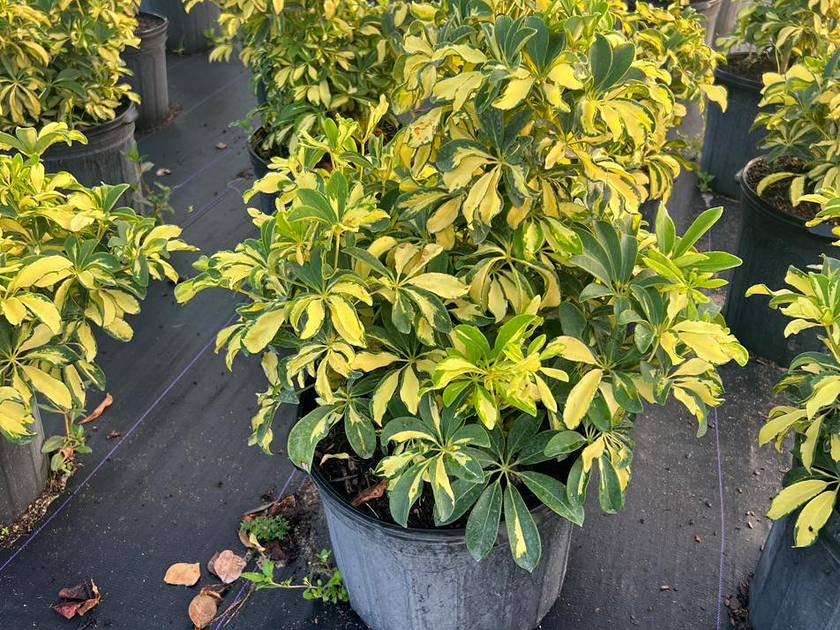
On variegated plants, check that the variegation is consistent — large sections reverting to plain green usually stay reverted.

4. Pests and disease
Turn leaves over. Most sucking pests live on the underside and in the leaf axils, and most infestations arrive in a garden on a purchased plant rather than appearing spontaneously.
| Look for | Suggests |
|---|---|
| Small brown or white bumps on stems and leaf backs | Scale |
| White cottony masses in leaf axils | Mealybug |
| Sticky residue on leaves or the pot rim | Honeydew — sucking insects above |
| Black sooty coating | Sooty mould growing on honeydew |
| Fine stippling and a dusty look | Spider mite |
| Distorted bronzed new growth | Thrips |
| Dark spots with yellow halos | Fungal or bacterial leaf spot |
A few chewed leaves are usually harmless and often a caterpillar that will become a butterfly. Sucking insects are the ones worth rejecting a plant over, because they multiply and spread.
5. Bigger is not better
Given two plants at the same price in the same container size, the larger one is frequently the worse buy. It has often been in that container longest, which means more root circling, more depleted medium, and a canopy the root system can no longer support.
A slightly smaller plant with a well-proportioned, non-circling root system will typically overtake it within a season, because it establishes faster and suffers less transplant shock.
The related question — what container size to buy at all — is a budget-versus-time decision. Small stock costs less and takes longer; large stock costs considerably more and gives immediate effect. For groundcover and fast shrubs, buy small. For trees and screening where you want usable height quickly, buying larger is usually worth it. Our nursery buying guide covers sizing in more depth.
6. Where you buy changes what you get
A retail garden centre buys from growers, holds stock on hot paving, waters it on a general schedule, and marks it up. A plant may sit there for weeks, becoming progressively more root-bound and stressed before anyone buys it.
Buying direct from a grower removes that stage. The plant is lifted from the growing rows and delivered, usually the same day, and it has been under a watering and feeding regime designed for growing rather than for holding.
There is a second advantage that matters for larger orders: you can see the whole batch. For hedging, matched grading across thirty plants is worth more than the average size of those plants, and you can only assess that by looking at them together. Our guide to buying direct from a grower goes into the difference.
7. A two-minute checklist
- Slide the plant part-way out of the pot. Roots pale and firm, not circling?
- Root flare visible where the stem meets the soil?
- Stems well distributed, foliage low on the plant if it is for a hedge?
- Leaf colour even, with active new growth at the tips?
- Leaf undersides and axils clean?
- Does it stand up on its own?
- Is the medium moist but not waterlogged, and does it smell earthy?
Seven checks, two minutes. It is the difference between a plant that establishes in six weeks and one that struggles for a year.
Come and walk the rows — see what we grow, or call ahead and we will have what you are after ready to look at.
Frequently asked questions
How can I tell if a plant is rootbound?
Is a bigger plant always better value?
What should healthy roots look like?
What should I check for on plant leaves before buying?
Why does the root flare matter when buying a plant?
Is it better to buy plants from a grower or a garden centre?
What container size should I buy?
References & further reading
- UF/IFAS EDIS — selecting quality nursery stock
- Florida Nursery, Growers and Landscape Association
- Florida Department of Agriculture and Consumer Services — nursery inspection
Come and look at the plants first. Call ahead and we will have what you are after pulled and ready — you can check the roots yourself before anything is loaded. Get a quote or call (786) 283-3401.