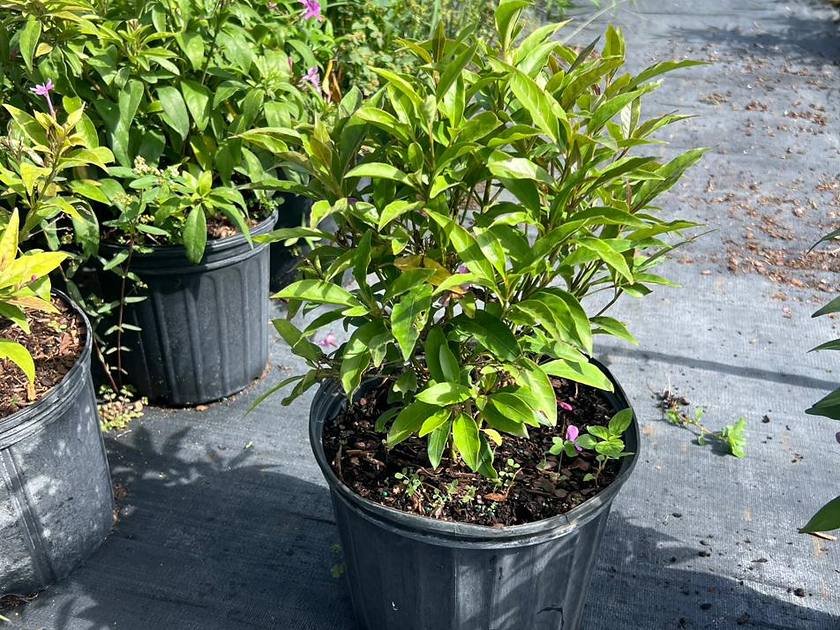
1. Start with the root ball
The part that determines whether the plant survives, and the part almost nobody checks.
Lift the plant gently by the stem base. If the whole root ball comes with it and feels solid, it has rooted in properly. If the plant spins or lifts free of the soil, it was recently potted up and has not established — it will struggle when planted.
Look at the drainage holes. A few fine white roots showing is a good sign. Thick roots spiralling out in a tight mass means the plant has been in that container too long, and those circling roots will keep circling after planting unless you cut into them.
Feel the weight. A pot that feels unexpectedly light is dry, which means it has been under-watered, possibly repeatedly.

2. Read the new growth
The tips tell you how the plant has been treated recently.
Full-sized, well-coloured new leaves mean the plant is actively growing and has what it needs.
Small, pale or distorted new growth means something is limiting it — nutrient, water or root problems.
Pale new leaves with green veins is interveinal chlorosis: iron lockout from alkaline soil. Very common in Miami and correctable, but you are buying a plant that will need attention. Detail in yellow leaves.
No new growth at all in growing season means the plant is holding rather than growing. Ask why.
3. Form matters most for hedging
For a single specimen, minor irregularities do not matter — the plant grows out of them.
For a hedge, they matter enormously. A run only reads as continuous if the plants match in height, width and density. One noticeably thinner plant in a line of twenty is visible for years.
Buy hedging from one batch. This is the strongest practical argument for buying from a grower rather than a retailer — a grower can supply a run from a single crop, while a retailer is assembling from whatever deliveries arrived.
Lay the plants out before planting and place any slightly weaker ones where they matter least — ends rather than the middle of a sightline.
4. Questions worth asking
The answers tell you as much about the seller as about the plant.
- How fast does this grow here? Not in general — in Miami-Dade.
- How wide does it get? The number that decides whether it fits your space, and the one most often glossed over.
- How much sun does it need? If the answer is vague, be cautious.
- Was it grown outdoors? Stock raised under shade or trucked from a cooler region has never been tested by these conditions.
- What is your guarantee, and what voids it? Get it in writing on the invoice.
Anyone who grew the plant can answer all of these without reading a tag. That is the practical difference between a nursery and a garden centre — more in buying plants direct from a grower.
5. Choosing a size
The decision that moves both cost and timeline more than species choice does.
Smaller stock is economical and establishes quickly, because a small root system fills surrounding soil fast. The right call when you have a season or two.
Larger stock buys time directly. For a boundary you need working now, or a focal plant in a finished bed, it is frequently worth the difference.
The counter-intuitive part: larger plants at wider spacing often cost about the same as small plants packed tight — and screen years sooner. Always ask for both options priced before deciding.
Call before you drive out. A quick conversation means the stock you want is on the ground and someone is free to walk the rows with you. (786) 283-3401.