In this guide
1. Buy for mature size, not pot size
Everything else in this guide follows from this one point.
A plant in a three-gallon container gives no useful information about what it becomes. Clusia in a pot is a tidy shrub; clusia in five years is six feet wide and pushing over your path. That gap is where small-garden regret lives.
Before buying anything, find out the mature width and check it against the space honestly. If the number does not fit, the plant does not fit — and no pruning regime fixes it permanently. You just spend every year cutting a plant back to a size it does not want to be.

2. Compact species that earn their space
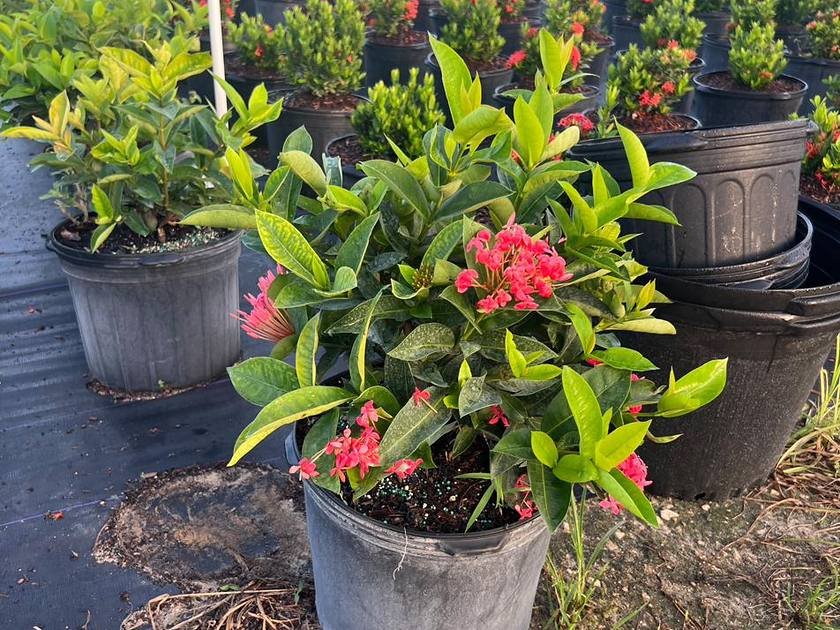
Dwarf ixora. The same continuous red and coral bloom as standard ixora at a fraction of the footprint. Ideal for foundation beds, low borders and anywhere near a walkway.
Variegated flax lily. Stays where you put it. Strappy cream-edged blades that hold form indefinitely without spreading into neighbours.
Blue daze. Spreads low rather than up, so it fills ground without occupying the space you actually use.
Variegated agave. A single specimen does more visual work than a group of small plants, which is exactly what a small garden needs. Site it away from paths.
Podocarpus. The narrow screening answer. Where clusia needs three feet of depth, podocarpus holds a much tighter profile — which is why it dominates tight side yards across the county.
3. Small-garden design that works
- Fewer species, repeated. Three species in drifts reads as designed. Twelve species reads as a collection, and in a small space that visual busyness makes the garden feel smaller still.
- One focal point, not four. A small space supports a single moment of drama. Competing focal points cancel each other out.
- Use vertical space. A narrow tall screen occupies less ground than a wide low one for the same privacy.
- Keep the middle open. Planting the perimeter and leaving the centre clear makes a small garden feel considerably larger than filling it evenly.
- Mass groundcover. Continuous low planting reads as one surface rather than as scattered individuals, which visually expands the space.
4. Boundaries and neighbours
On a small lot, planting is nearly always close to a boundary — which introduces a problem that is much easier to avoid than to resolve.
Check mature width against the property line. A hedge planted a foot inside your boundary will be growing over your neighbour’s side within a few years. That conversation is avoidable.
Leave working room. Two to three feet between a hedge and a fence lets air circulate behind it and lets you physically trim the back. Planted tight against a fence, a hedge grows one-sided and you cannot maintain it.
Check HOA rules. Height limits and approved species lists are common, and worth confirming before ordering rather than after planting. Spacing detail in the hedge spacing guide.
Send measurements and photographs. On a small lot the numbers matter more than anywhere else — we will tell you honestly what fits. Get in touch.