In this guide
1. Why hedges go bare at the bottom
This is the most common hedge complaint, and the cause is almost always the shape it has been cut into.
If a hedge is trimmed with a flat face or — worse — slightly wider at the top, the upper growth shades the lower growth. Shaded foliage thins, drops and does not regrow. Over a few seasons the bottom two feet go bare and the hedge stops screening at exactly the height you needed it.
The fix is geometry. Cut the hedge so the base is slightly wider than the top — a subtle taper, only a few inches over the height. Light then reaches the bottom and the hedge stays full from the ground up.
Correcting an already-bare hedge is slow, and sometimes replacement is more honest. But cutting it right from the beginning costs nothing extra.

2. When to prune what
Structural pruning: early spring, before the main growth flush. The plant recovers fast and you are not removing wood that would have carried flowers.
Flowering species: immediately after they bloom. Prune later and you are cutting off next season’s flower buds. This is why ixora sometimes stops flowering after a well-meant tidy-up.
Hedges: light trims through the growing season keep the shape without shocking the plant. Frequent and light beats occasional and severe.
Before 1 June: complete any canopy thinning ahead of storm season. Wind passes through an open canopy and pushes a solid one over.
Do not prune heavily: when a storm is named, or going into the cooler months, when soft new growth is most vulnerable.
3. How much to take
Never more than a quarter of the canopy in one session. Beyond that the plant is running on stored energy with insufficient leaf area to replace it, and recovery takes seasons rather than weeks.
The temptation is to let a plant run for years and then halve it. That is a severe shock and frequently costs a full season of appearance — sometimes the plant itself.
Small annual cuts are easier on the plant and considerably easier on you. A hedge kept at its intended size takes minutes; a hedge reclaimed from five years of neglect takes a weekend and looks rough for months.
4. Technique that matters
- Sharp blades. A dull blade tears rather than cuts, and torn tissue invites disease in our humidity.
- Cut back to a growth point. Stubs left between nodes die back and look untidy.
- Thin the interior periodically. Removing some interior growth lets air and light into the middle of a dense plant. In Miami humidity, poor airflow inside a hedge invites fungal problems.
- Step back frequently. Shape is much easier to judge from six feet away than from arm’s length.
- Clean tools between diseased plants. Pruners spread problems efficiently.
5. Species-specific notes
Clusia tolerates hard pruning better than almost anything and regenerates readily. Forgiving if you have let it go.
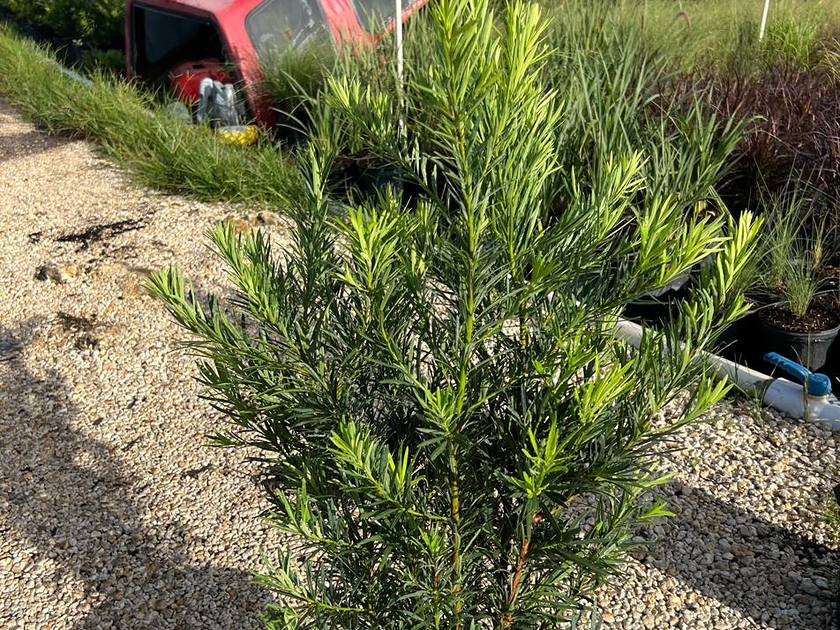
Podocarpus takes a crisp formal edge and holds it, which is why it dominates clipped hedging here. Trim regularly to keep the line.
Ixora — prune after flowering, never before. Shearing it into a formal shape removes most of the flower.
Copperleaf and arboricola respond well to tip-pruning, which encourages density rather than length.
Agave should not be pruned at all beyond removing genuinely dead lower leaves. Cutting into healthy tissue ruins the form permanently.
Firebush and other natives look best in natural form. Shearing them into balls removes exactly the flowering wood that made them worth planting.
Inherited an overgrown hedge? Send photographs and we will tell you honestly whether it can be reclaimed or is better replaced. Ask us.