In this guide
1. Specify for the maintenance you will actually get
This is the point everything else follows from.
A private garden is visited by someone who notices things. A commercial property is visited on a schedule by a crew working quickly across many sites, with mechanical trimmers and an irrigation controller nobody adjusts between seasons.
Species that need deadheading, careful hand-pruning or attentive watering will not get any of it. They do not die — they just look progressively worse, which on a commercial frontage is the same problem.
Specify for the regime you will actually have, not the one described in the maintenance contract.

2. Four criteria that matter
- Tolerates hard shearing. Clusia and podocarpus take mechanical trimming without sulking, and regenerate from cuts that would set other species back a season.
- Holds colour without intervention. Foliage colour — copperleaf, variegated arboricola — carries a scheme year-round. Flowering species look good briefly and ordinary the rest of the time.
- Survives set-and-forget irrigation. Drought-tolerant species forgive a controller left on winter settings through August, or summer settings through January.
- Recovers from damage. Parking islands, walkway edges and building surrounds take physical abuse. Species that regenerate from hard cuts reduce replacement cost substantially over a property’s life.
3. Consistency is the commercial problem
On a residential job you buy plants once. On a commercial portfolio you buy the same plant repeatedly, across properties and across years — and that is where schemes visibly come apart.
Stock brokered from whichever wholesaler had availability that week varies in form, colour and how it was grown. Placed side by side down a two-hundred-foot frontage, the run reads as patched rather than planted.
Buying from a grower who holds the specification solves this. A long run comes from a single batch, and when you return in eighteen months to replace storm losses, the supplier knows exactly what went in. That continuity is worth more on a commercial job than a small price difference per plant.
More on how we handle this in commercial landscaping.
4. Matching species to site conditions
Street frontage and entrances. Clusia or podocarpus for structure, with variegated agave as periodic accent. High visibility, so consistency matters most here.
Parking islands. Brutal conditions — reflected heat, compacted soil, physical damage. Silver buttonwood and agave handle it; most flowering species do not.
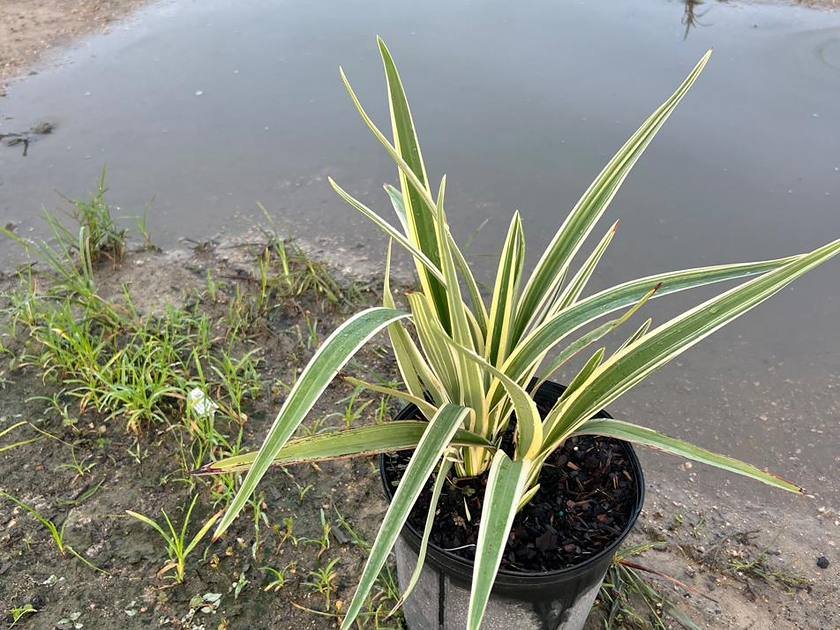
Building surrounds and shaded walkways. Variegated arboricola and flax lily, which hold colour where sun-lovers thin.
Exposed or coastal sites. Cocoplum and silver buttonwood. See salt-tolerant plants.
Slopes and difficult ground. Massed groundcover — blue daze, flax lily — which stabilises soil and eliminates mowing.
Send the specification and the maintenance schedule. We will tell you honestly which species will still look right in year three. Get a quote.