In this guide
1. Treat it as a room
The most useful shift in thinking for a small garden is to stop designing a landscape and start designing a room. A room has a floor, walls, a ceiling of sorts, a focal point and somewhere to sit. Small gardens that fail usually have a floor and some scattered plants and nothing else.
In practice that means deciding the boundary treatment first — the walls — then the paving or lawn, then the focal point, and only then the planting that fills between. Most people do it in the opposite order and end up with plants arranged around a space that has no structure.
2. Layer upward, not outward
In a small footprint the available planting area is horizontal, but the available volume is vertical. Three layers rather than one is what makes a compact garden feel planted rather than decorated.
- Upper layer. A single small tree, or a tall narrow screen along the boundary. In Miami, a Christmas palm, a small tabebuia or a clipped podocarpus column works without dominating.
- Middle layer. Shrubs at eye level and below — clusia kept at four feet, ixora, plumbago, croton. This is where colour and texture live.
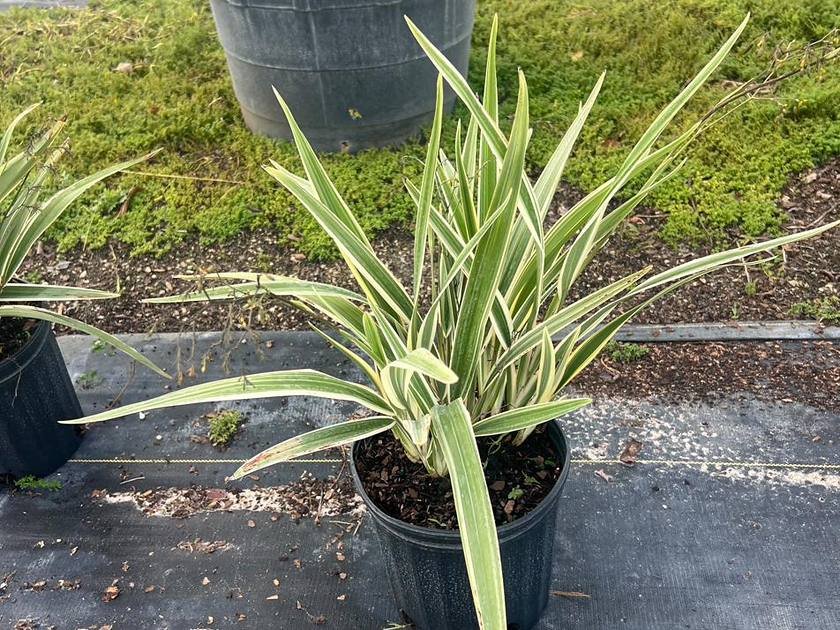
- Lower layer. Groundcover and low accents that finish the edges — liriope, flax lily, perennial peanut, small ferns.
A garden with only a middle layer reads flat. A garden with all three reads considered, even at 20 by 30 feet.

3. Fewer species, repeated
The instinct in a small garden is to fit in as many different plants as possible. It produces visual noise. The professional move is the opposite: choose three or four species and repeat them deliberately.
Repetition creates rhythm, and rhythm reads as intention. Five plants of one species along a bed edge look designed; five different plants look like a collection. It also makes maintenance simpler, because everything in a bed wants roughly the same water, light and feeding.
A workable rule for a small Miami garden: one screening species for the boundary, one or two flowering or foliage shrubs for the middle, one groundcover for the edges. Four plants total, repeated.
4. Mature size is the constraint
This is where small gardens are most often lost. A 3-gallon clusia is an 18-inch plant that becomes a 12-foot shrub. A philodendron in a nursery pot becomes eight feet across. Planted at nursery spacing, a small garden is congested within three years and needs ripping out.
Check mature dimensions before anything else, and be sceptical of plants whose mature spread exceeds a quarter of the bed width. If a plant is right in every way except size, there is usually a dwarf cultivar — dwarf ixora, dwarf clusia, dwarf firebush — bred exactly for this problem.
| Common plant | Nursery size | Mature size | Small-garden verdict |
|---|---|---|---|
| Clusia guttifera | 18–24 in | 8–12 ft | Yes, if kept clipped as a screen |
| Areca palm | 5–6 ft | 20 ft tall, 12–15 ft wide | No — needs too much width |
| Dwarf ixora | 12–18 in | 2–3 ft | Yes |
| Philodendron selloum | 2 ft | 6–8 ft across | One as a focal point only |
| Christmas palm | 6–8 ft | 15–20 ft | Yes — slim and well-behaved |
| Bird of paradise | 2–3 ft | 5–6 ft clump | Yes, as a single accent |
5. Sightlines and the far corner
A small garden feels larger when the eye can travel uninterrupted to the furthest point. Anything placed in the middle of that line — a specimen shrub, a pot, a bench — stops the eye short and the space contracts.
Keep one clear diagonal from the main viewpoint, usually the door or window you look out of most, to the opposite corner. Diagonals are longer than straight lines across a rectangular plot, which is why the trick works.
Then give that far corner something worth arriving at — a specimen plant, a light, a piece of stone. The eye travels, lands on something, and reads the space as deeper than it is.
6. Materials, light and scale
Fewer, larger paving units read as more spacious than many small ones; the same logic applies to planting. A continuous mass of one groundcover looks larger than a patchwork of three.
Lighting is disproportionately effective in a small garden because the whole space is within range. Two or three uplights on a boundary screen and one on the focal plant extend usable hours and make the garden read as part of the house after dark.
Keep the boundary screen as one species where possible. A mixed boundary chops the space visually into segments; a single continuous green wall reads as an edge and lets everything in front of it stand out.
7. A worked example
A typical Miami rear garden of 25 by 35 feet, full sun, sandy soil, overlooked from one side.
- Boundary: clusia at 24-inch centres along the overlooked side and the rear, maintained at six feet. One species, continuous.
- Upper accent: a single Christmas palm offset from centre in the far third, uplit.
- Middle layer: dwarf ixora repeated in groups of three along the two side beds, with plumbago at the shadier end.
- Lower layer: flax lily edging both beds, continuous, so the beds read as deliberate shapes.
- Floor: large-format pavers with a small lawn or gravel panel; one clear diagonal kept open.
- Irrigation: drip along both beds and the hedge run, on separate zones from any lawn.
Four plant species, three layers, one open sightline. It costs less than a mixed scheme, maintains more easily, and looks finished in eighteen months rather than five years.
If you want help specifying it, see garden design or tell us the dimensions and we will suggest a plant list.
Frequently asked questions
How do you make a small garden look bigger?
What plants work best in a small Miami garden?
How many different plants should a small garden have?
How far apart should I plant shrubs in a small garden?
Can you have a lawn in a small Miami yard?
Is a hedge a good idea in a small garden?
References & further reading
Send us the dimensions and a photo. We will suggest a plant list built around mature size, so the garden still works in year five. Get a quote or call (786) 283-3401.